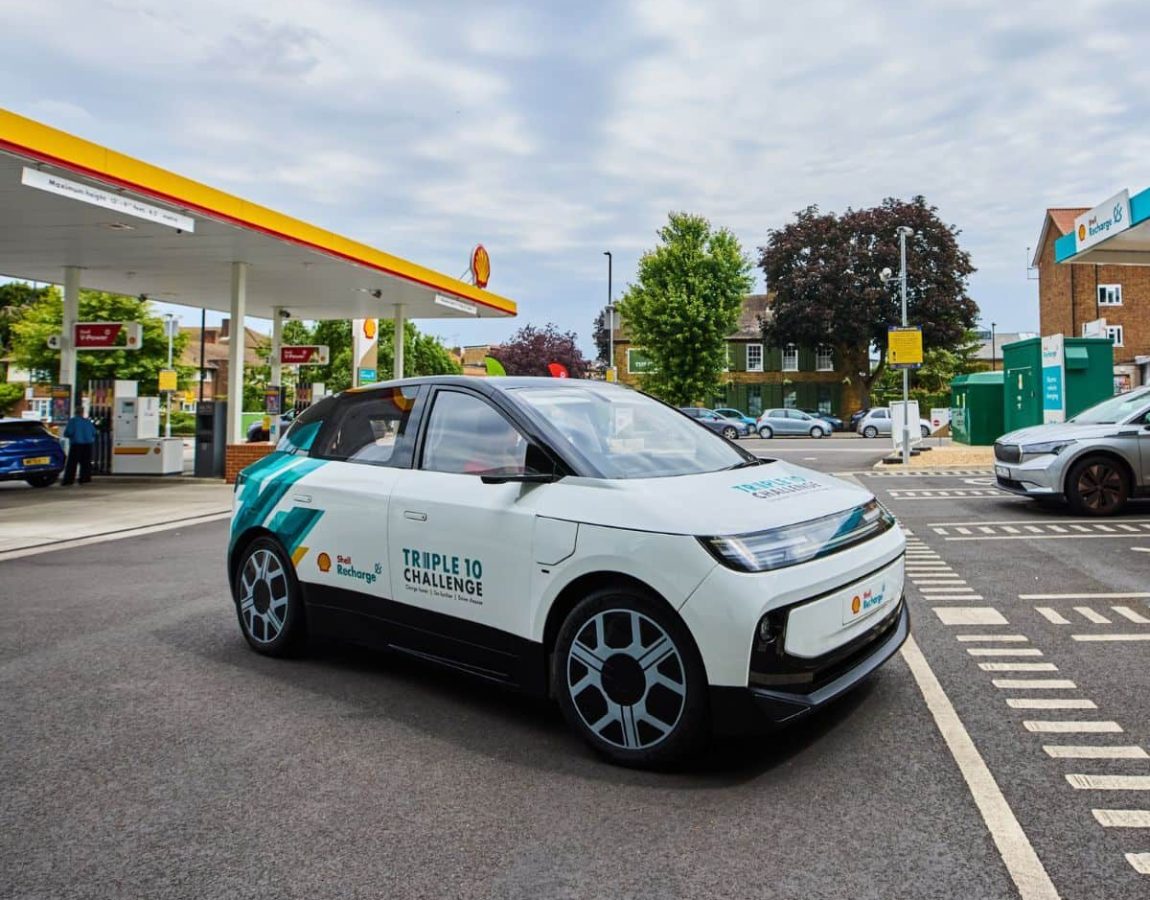
Chasestead Ltd designed and built the complete chassis for Shell’s future-of-mobility concept vehicle — pioneering new fabrication techniques in recycled aluminium extrusion to create a structure that is as technically innovative as the car itself.
CLIENT: Shell
COMPLETED: February 2025
OVERALL TOLERANCE: ±1.5mm
MATERIAL: Recycled Aluminium Extrusion
THE BRIEF
Shell commissioned Chasestead to engineer and fabricate the chassis for a concept car exploring the future of electric mobility. The vehicle needed to embody Shell’s commitment to sustainability — not just in its powertrain, but in every material and process involved in its construction. That brief started with the chassis itself.
The specification called for a structure built entirely from recycled aluminium extrusion: a material choice with strong sustainability credentials but one that presented significant fabrication challenges at the precision levels a concept car demands. There was no existing playbook for doing this at this standard. Chasestead would need to develop new techniques from the ground up.
The material was chosen for what it stands for as much as what it can do — our job was to make recycled aluminium perform like a precision engineering material.

THE LOW VOLUME CHALLENGE
Building a one-off concept car is a fundamentally different engineering problem to series production — and in many ways a harder one. In volume manufacturing, tolerances are achieved through repetition: processes are dialled in over thousands of parts, fixtures are refined, and variation is averaged out across a run. When you are building a single vehicle, none of those advantages exist. Every component has to be right, first time, and the overall structure has to come together within tolerance from a standing start.
For the Shell concept car, Chasestead worked to an overall assembly tolerance of ±1.5mm across the complete chassis — a demanding target for a structure of this complexity, built from a material and using processes that had never been combined in this way before. With no production run to learn from, and no margin to accommodate cumulative error, every stage of the build had to be controlled with the same rigour you would expect of a production programme.
In low volume, there is nowhere to hide. Every part, every joint, every bond has to land in the right place — because there is no next batch to correct it.
To achieve this, Chasestead deployed their MetroScan laser measurement system throughout the build process. Rather than relying solely on the assembly fixtures to guarantee position, each component and sub-assembly was laser scanned and verified against the CAD model before the next stage proceeded. Any deviation was identified and resolved before it could accumulate into a larger error downstream.
This combination of precision fixturing and in-process laser verification is what makes low volume builds at this standard achievable. The fixtures define the nominal position; the MetroScan confirms it has actually been achieved.
NEW TECHNIQUES DEVELOPED
Three distinct fabrication challenges required Chasestead to develop entirely new processes — capabilities that did not previously exist within the company, and in some cases within the industry at this scale.
Bending recycled aluminium extrusion at the accuracy required for chassis geometry is not straightforward — extrusion profiles resist bending and can deform unpredictably. Chasestead developed specific tooling and process controls to bend the extrusion cleanly and repeatably to the exact radii the chassis design demanded.
5-axis laser cutting of aluminium extrusion was required to create the precise joint geometries and cut-outs that allow the chassis members to fit together accurately. Applying 5-axis laser cutting to profiled extrusion — rather than flat sheet — required careful programming and fixturing to hold complex profiles securely and cut to the tolerances a structural chassis demands.
Assembly fixtures were designed and built by Chasestead to hold every chassis component in its correct position during assembly and bonding. Without accurate fixtures, the tolerances achieved in fabrication cannot be maintained through the build process. Each fixture was engineered to the chassis geometry, ensuring the finished structure was dimensionally accurate throughout.
THE BUILD
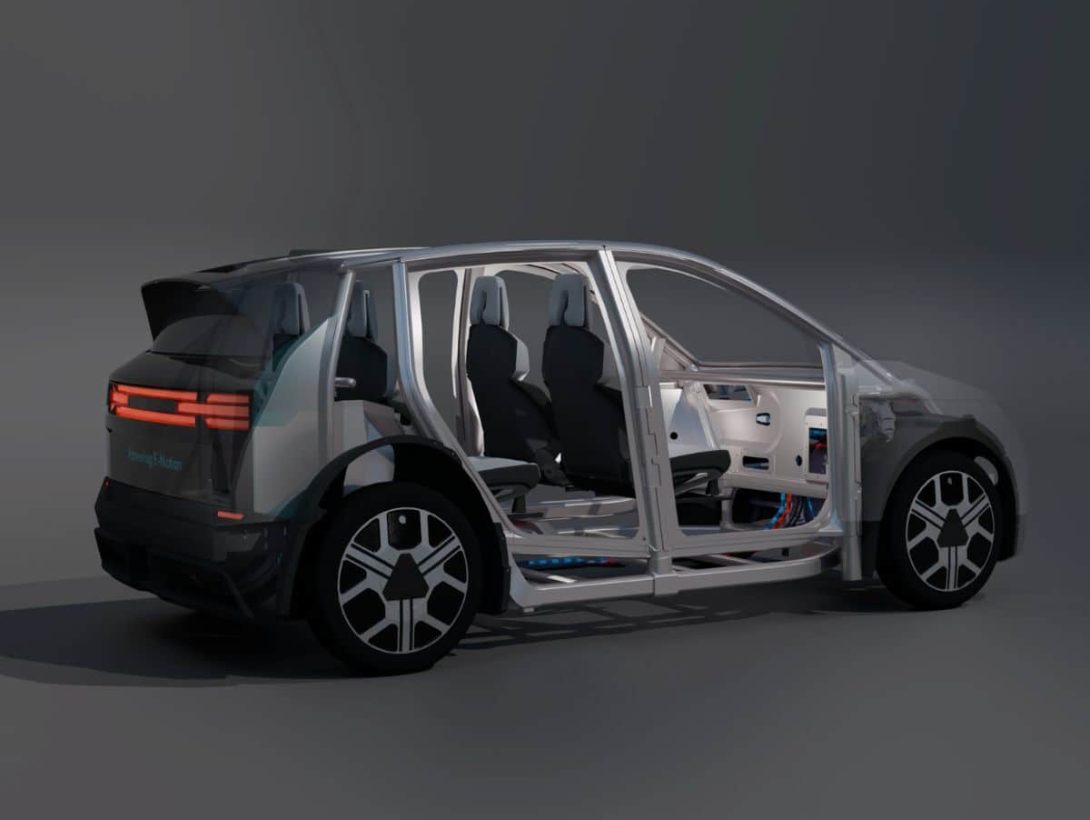
With the fabrication techniques established and the assembly fixtures in place, Chasestead built the complete chassis — bonding the aluminium extrusion members structurally rather than welding, a process that distributes loads more evenly and avoids the heat distortion that welding can introduce into precision structures.
The composite panels — both internal and external — were bonded into the chassis assembly as an integral part of the structure. Managing the interface between aluminium extrusion and composite panel, and ensuring consistent bond quality throughout, required close attention to surface preparation, adhesive selection, and the sequencing of the assembly process.
The result is a chassis in which metal and composite work together as a unified structure, each material used where its properties are best suited.
THE OUTCOME
The completed chassis was delivered to Shell in February 2025, ahead of the concept car’s public reveal. Every structural and dimensional requirement was met, and the finished assembly demonstrates that recycled aluminium extrusion can be fabricated and bonded to the standard required of a precision automotive structure.
For Chasestead, the project represents a significant expansion of capability: new bending and cutting processes, new fixture-making methods, proven expertise in structural bonding of mixed aluminium and composite assemblies, and MetroScan laser verification — all developed specifically for this commission and available for future projects.
KEY OUTCOMES:
Sustainable by Design
Full chassis fabricated from recycled aluminium extrusion, meeting Shell’s sustainability brief from the ground up.
Complete chassis assembly held to 1.5mm overall tolerance — achieved first time on a one-off low volume build.
Bespoke extrusion bending and 5-axis laser cutting of profiled extrusion developed in-house for this project.
In-process laser scanning used throughout the build to verify component position against CAD before each stage.
Full set of assembly fixtures designed and built to maintain chassis geometry throughout the bonding process.
Aluminium extrusion and composite panels bonded as a unified chassis structure — metal and composite working together.